
Lighting Journal
Alabaster vs. Glass Lighting: Which Suits Your Room?
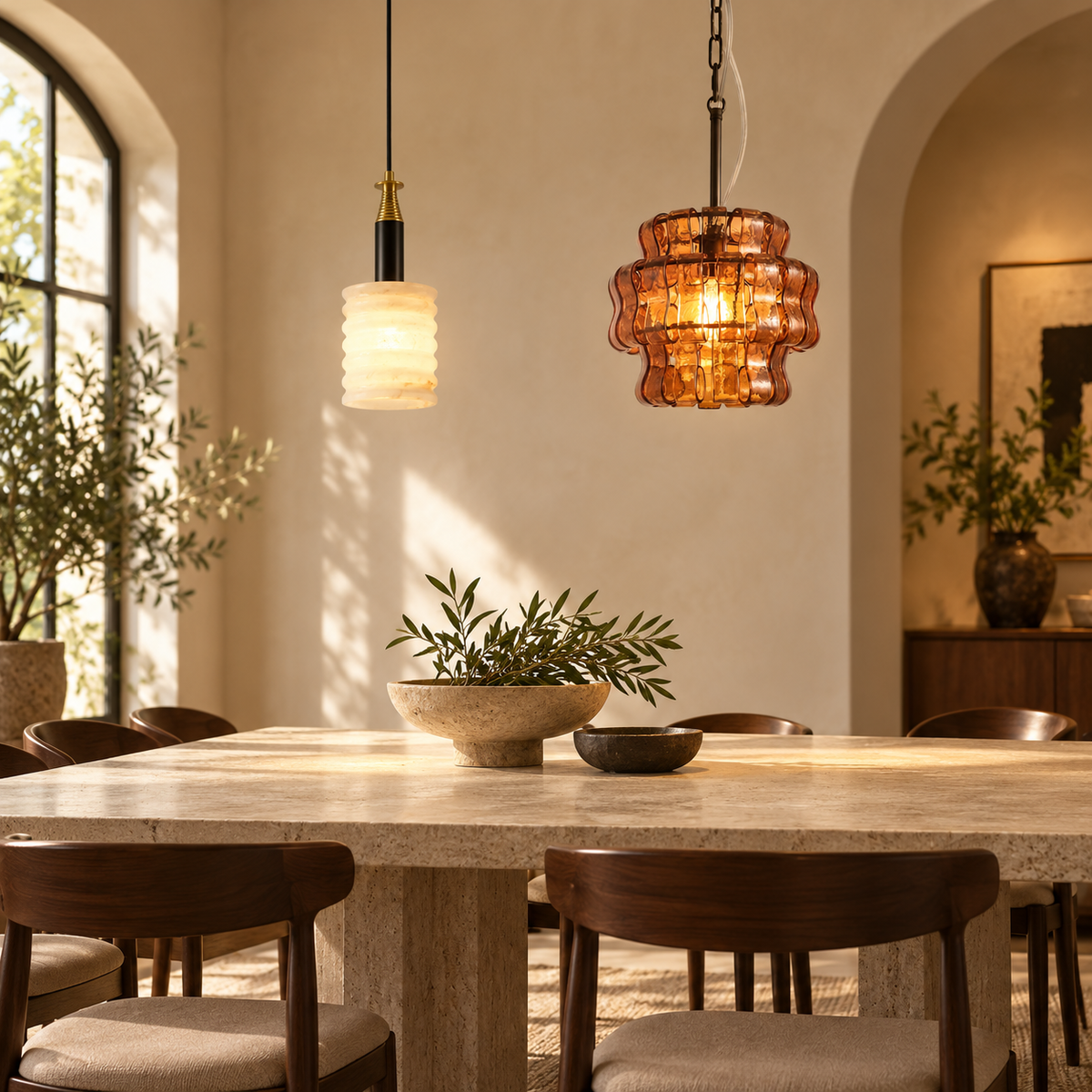
Choose alabaster if you want natural stone variation visible even with the light off; choose glass if transparency, color, or a particular texture matters more. For a dining table, compare the lit fixture and the view across it; for a bedroom, look at glare from the pillow; for an entrance, check how the fixture looks by day as well as at night. The shade shape and light source still determine much of the final effect.
Look at the fixture with the light off
A chandelier occupies space all day, even when it is not switched on. Natural alabaster may show changes in tone and pattern from one stone element to another. That variation can sit comfortably beside timber, plaster, linen, and other tactile surfaces. If you need several shades to match closely, ask what variation to expect from the specific fixture before ordering.
Glass offers a different range of possibilities. Clear glass reveals more of the bulb and inner structure; frosted or opal glass softens the view; colored and textured glass adds another note to the room. These are design types, not promises about every glass fixture. Compare photographs taken both on and off, and request product-specific details when the finish is central to your scheme.
| Question | Alabaster | Glass |
|---|---|---|
| What do you see by day? | A stone surface with natural variation. | Clear, frosted, colored, or textured surfaces, depending on the design. |
| What happens when lit? | Translucent stone may show its natural pattern. | Transparency and texture change how much of the bulb and inner structure you see. |
| What about matching shades? | Veining varies from piece to piece. | Compare the actual finish and manufacturing method; appearance varies by model. |
| How do you care for it? | Follow the stone fixture’s instructions; avoid assuming water is safe. | Follow the glass fixture’s finish and assembly instructions. |
Then look at the light itself
Material influences the way a fixture appears when lit, but the shade shape, thickness, bulb or integrated light source, and placement matter too. A thin alabaster element can reveal its natural pattern as it glows. A glass shade may let you see a clear point of light or may diffuse it almost completely. Neither material alone tells you whether the fixture will provide enough light for dining, reading, or moving through a room.
Use the product’s actual light-source information to decide whether more lighting is needed elsewhere in the room.
Consider the room’s scale and style
Alabaster can give a simple silhouette more visual weight because the stone remains present in daylight. That can be appealing when the room has pale walls and restrained furnishings. Glass can keep a larger fixture visually lighter, especially where you want a view to continue through the dining room or entryway. A colored glass shade can do the opposite and become the focal point.
Test scale before you commit. Measure the fixture’s overall width and height, then compare those numbers with the table, seating area, or hallway it will occupy. A material choice cannot rescue a fixture that blocks the room’s main sightline or sits at an awkward height.
Choose for a dining room, bedroom, or entrance
Above a dining table: alabaster makes the fixture a visible material feature even when switched off; clear glass can keep the view through the room more open. Check glare at seated eye level with the intended bulb.
In a bedroom: a translucent or diffusing shade can make the light source less exposed. Compare specific stone and glass designs from the bed; neither material guarantees comfortable reading light.
At an entrance: look at the fixture from the doorway in daylight. Natural veining can add detail to a simple space, while colored or textured glass can make a stronger first impression. Keep the walking route and door swing clear.
Think about care before choosing
Genuine gypsum alabaster is soft and water-sensitive. The U.S. National Park Service’s guide to caring for alabaster recommends gentle dry brushing for museum objects. For a new light, follow its own care instructions before cleaning the stone.
Glass care also depends on the shade’s decoration, finish, and assembly. A removable plain-glass shade is not the same as a painted or permanently attached one. Confirm whether the shade can be removed, which surfaces may be wiped, and how to keep moisture away from electrical parts.
See the difference in two Auvielight designs
The Ribbed Alabaster Pendant Light uses a genuine alabaster cylinder with natural veining and a replaceable E14 bulb. Its product listing rounds the two diameters to 4.8 and 6 inches (12 and 15 cm). By comparison, the Tiered Rippled Glass Pendant Light uses two layers of wavy glass around a metal frame; its listed fixture dimensions are 13 inches in diameter and 10.6 inches high. The glass version has clear, smoke gray, amber, and green shade options with gold or black metal finishes. Compare the exact color variant and bulb choice before judging the final effect.
Choose the material, then the fixture
Choose alabaster for its natural pattern, or glass for a particular transparency, color, or texture. Then compare specific designs for dimensions, light source, installation, and care.
Browse Auvielight’s Alabaster Lighting and Pendant Lights collections to compare the exact shapes and materials.
Sources and further reading
- U.S. National Park Service, Care of Alabaster — stone properties and gentle dry care.
- Canadian Conservation Institute, Care of Ceramics and Glass — glass properties and care considerations.
These conservation guides concern museum objects; use the instructions for your specific light when cleaning it.