
Lighting Journal
Bedroom Lighting Before Sleep: What 2026 Research Supports
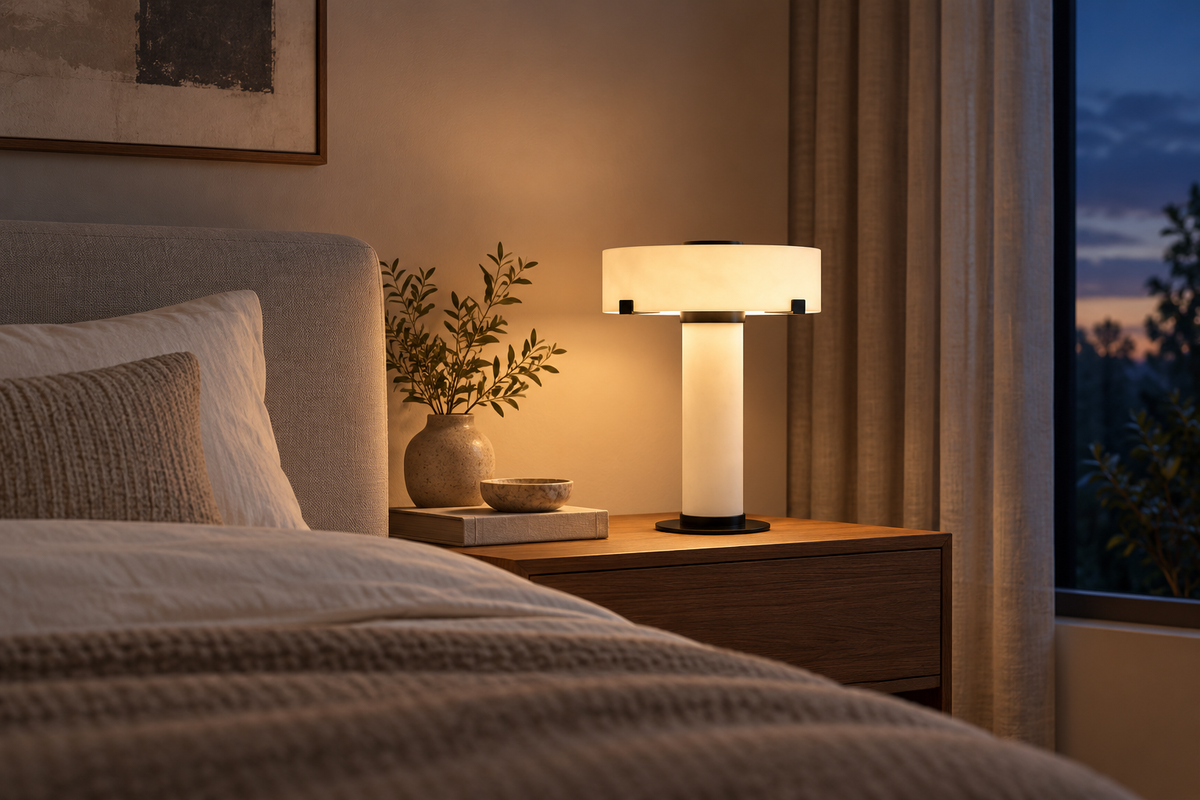
Short answer: For an evening bedroom, make the light low enough for winding down, keep the useful lamp near the activity, and turn it off when it is no longer needed. A warm color appearance can be part of that plan, but a 3000K label on its own does not measure the light reaching your eyes or promise better sleep. Brightness, timing, exposure duration and the full spectrum all matter.
This distinction matters because recent research and 2026 professional guidance are more careful than many product claims. An August 2026 position statement from the Society of Light and Lighting says established principles should be separated from emerging evidence and warns against overclaiming what an “integrative” lighting design can do. A bedroom is a place to make modest, controllable choices, not to promise a medical result from one lamp.
What a 2026 lamp study actually measured
A January 2026 Scientific Reports study measured the emissions of 52 household lamps and modeled their potential effect on melatonin suppression. In that sample, cool-white lamps produced higher modeled suppression than warm-white lamps. The result supports looking beyond “LED” as a category and considering the light's spectrum. It was not a trial showing that a particular bedside fixture improves sleep: the reported suppression values came from calculations under assumed exposure conditions, not direct measurements of people sleeping in their homes.
Build an evening scene you can control
- Use only the light you need. A low-output or dimmed lamp near a book is more useful than a bright overhead source across the whole room. Keep enough light to move safely.
- Check the seated view. From the bed, look for exposed bulbs or a glowing source aimed directly at the eyes. Move or shield the fixture if it creates glare.
- Let the room get darker. Switch lights off when the task ends and limit stray light from windows or screens. The Sleep Foundation's June 2026 review recommends dim light while preparing for bed and a dark sleeping environment.
Read the product page more closely than the color name
The Auvielight Solid Bedside Lamp is listed with a fixed 3000K integrated LED, a 15-inch diameter, an 18.9-inch height and a plug-in cord with an inline switch. Its listing does not specify dimming or the measured light level at the bed. Those missing details matter if your plan depends on a very low evening brightness. Check the chosen fixture's control and output information before deciding it will serve your routine. Browse Bedroom Lighting with those questions in mind.
Good bedroom lighting is a sequence: enough light to read or move, less light as the evening winds down, and darkness for sleep. Choose each source for its actual behavior in your room, not a health promise attached to its color temperature.
Sources
- Society of Light and Lighting, “Integrative (Circadian) Lighting Position Statement,” August 2026 — professional guidance on evidence and uncertainty.
- Terán et al., “Home lighting, blue-light filtering, and their effects on melatonin suppression,” Scientific Reports, 2026 — lamp-spectrum measurements and modeled, not clinical, effects.
- Sleep Foundation, “Light and Sleep,” updated June 2026 — practical evening light and bedroom environment guidance.
- Auvielight, Solid Bedside Lamp product details — listed dimensions, fixed color temperature and control.