
Lighting Journal
Clear or Opal Glass Chandelier? Choose by the View and the Drop
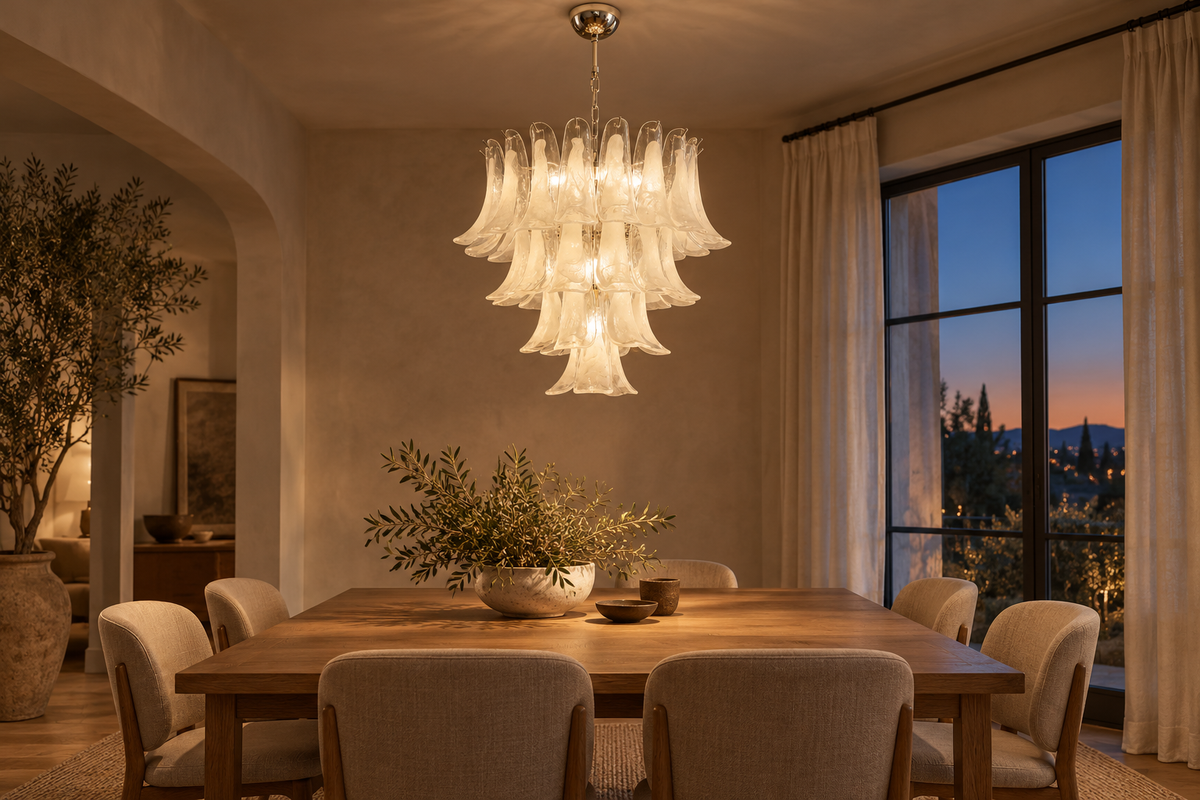
Short answer: Choose clear textured glass when you want to see the glass detail and more of the light source; choose opal glass when you want the glass itself to read as a lighter, cloudier surface. Then check the fixture's body height and bulb view from the dining chairs. Glass alone does not tell you the light output or guarantee glare-free dining.
Decorative glass has a strong place in 2026 lighting: Kichler's 2026 trends review singles out ribbed and fluted texture, while Hudson Valley Lighting Group's February 2026 glass guide describes how different textures and finishes change the appearance of a lit fixture. Those are design directions. Your own table height, ceiling and normal seated view still decide which chandelier works.
Compare the off-state first
Stand at the room entrance in daylight. With clear glass, the supporting metalwork and bulbs tend to remain part of the composition. With opal glass, the glass surface is more visually present and the inner details tend to be less apparent. The exact result depends on the fixture and bulb, so review both lit and unlit product photographs before choosing.
Two Auvielight examples show why the label alone is not enough. The Modern Lotus Leaf Chandelier is listed in clear textured glass and a clear-and-gold finish. Its available body diameters are 19.7, 23.6 and 31.5 inches. The Sculptural Lily Blossom Chandelier is listed in opal glass with a white-cloud glass option and polished-nickel-finish hardware, in the same three nominal diameters. Their silhouettes and finishes are different as well as their glass.
Look from the chair after dark
At the table, an exposed bright bulb can be uncomfortable even if the chandelier looks balanced from the doorway. Sit at the actual chairs and look toward the fixture's proposed height. Ask whether the bulbs will be directly visible from those positions and whether the bulb choice suits the socket and fixture limit. The Lily Blossom product page lists replaceable E12 or E14 candelabra bulbs and a maximum of 25 watts per socket. The Lotus Leaf lists an E12 or E14 base, but its page does not publish a comparable per-socket wattage limit. Neither product page gives measured room illuminance, so do not infer that one will be brighter than the other.
Check vertical fit separately from width
At the shared 19.7-inch diameter, the Lotus Leaf's listed body height is 27.6 inches; the Lily Blossom's is 18.9 inches, an 8.7-inch difference before suspension is counted. Kichler suggests starting a dining chandelier about 30 inches above the tabletop, with some adjustments for larger tables and taller rooms. Measure from ceiling to table, subtract the desired light-to-table gap, and compare what remains with the complete installed drop. The Lotus Leaf lists an 11.8-inch chain that can be adjusted on request; the Lily Blossom lists a 59-inch chain adjustable on installation. Neither body height alone proves the final fit.
If both glass options appeal, make the decision in this order: seated bulb view, installed drop, full silhouette in daylight, then finish. Explore Dining Room Lighting for other shapes. For a separate material comparison, read our alabaster-versus-glass guide.
Sources
- Kichler Lighting, “Trends 2026” (January 2026) — current context for textured glass.
- Hudson Valley Lighting Group, “HVLG's Glass Guide” (February 2026) — visual roles of glass texture and finish.
- Kichler Lighting, “Chandelier Planning and Selecting Tips” — dining-table hanging-height starting point.
- Auvielight, Modern Lotus Leaf Chandelier and Sculptural Lily Blossom Chandelier — current product dimensions, materials and bulb details.